
L'Arroseur Arrosé - Wikipedia, the free encyclopedia
https://en.wikipedia.org/wiki/L'Arroseur_Arrosé
L'Arroseur arrosé (also known as The Waterer Watered and The Sprinkler Sprinkled) is an 1895 French short black-and-white silent comedy film directed and ...1895 - L'arroseur Arrose' - YouTube

https://www.youtube.com/watch?v=0E0IenGJ09o
Jan 22, 2009 - Uploaded by phantomshark
L'Arroseur Arrosé (also known as The Waterer Watered and The Sprinkler Sprinkled) is an 1895 French short ...Auguste & Louis Lumière: L'Arroseur arrosé (1895) - YouTube

https://www.youtube.com/watch?v=Frl0K09o-KA
Oct 19, 2009 - Uploaded by iconauta
Breve Storia del Cinema - Il cinema dei Lumière: http://www.LOUIS LUMIERE - L'Arroseur Arrose - YouTube

https://www.youtube.com/watch?v=IooPPi1YzkM
Nov 29, 2011 - Uploaded by Change Before Going Productions
The Sprinkler Sprinkled (1895) - 1st Comedy Movie - LOUIS LUMIERE - L'
 Cinema before 1900 - the origins
allaboutartandfilm.blogspot.
L'Arroseur arrosé (also known as The Waterer Watered and The Sprinkler Sprinkled) is an 1895 French short black-and-white silent comedy film directed and ...
The
Lumieres later continued to develop the technology. Yet when Georges
Melies (the one who would soon became the first artist of the medium)
tried to buy .
Cinema before 1900 - the origins
Before 1900 - an optical toy?
The pioneers
- for decades, moving image entertainment was done through 'magic lanterns'
- soon a great deal of ingenuity was applied to obtaining the effects of movement by means of mechanical lantern slides (with levers, ratchets and sliding panels)
- From 1860s, lanternists began to apply a technique known as 'the persistence of vision', which served as the fundamental physical principle of cinema -- our retina retains an impression for a fraction of a second after being exposed to the image. This was studied by physicists Peter Mark Roget and Michael Faraday (British), Joseph Plateau (Belgian), and Simon Stampfer (Austrian)
- Plateau and Stampfer independently conceived the idea of a disc with a series of drawings around the edge. The disc was spun and the images were viewed in a mirror through slots cut in the disco's perimeter
Horner's Zoetrope, 1834

- images were arranged on a band inside a drum and were viewed as it was rapidly spun through slits cut in the upper half of the drum opposite the images.
- the slits kept the pictures from blurring together, and the viewer would see a rapid succession of images, creating the illusion of motion
Reynaud's Praxinoscope, 1876

- substituted a polygonal drum of mirrors. As the device was spun at the centre of the outer drum of images, it momentarily reflected their rapid succession, giving a bright and clear impression of movement.
- Then came the 'Praxinoscope a Projections' in which images are semi-transparent. Light passed through the images reflected off the spinning mirrors on the screen.
- In 1892, Reynaud presented the 'Pantomimes Lumineuses' - a continuous band of images for projection it came a significant stage nearer to the cinema we know today. Movements were no longer restricted to the cyclic limits
- The film-maker was still required to draw his images.
Muybridge's phenakistiscope, 1877


- British but went to America
- When asked by California Governor Stanford to produce instantaneous photographs of his race horse, he started a series of experiments.
- set up a battery of cameras alongside a track, their shutters being release in turn as the horse set off a trigger by touching a cord as it passed each camera.
- After this successful experiment, Muybridge continued to publish series of photographs of different kinds of human and animal movements.
- projected the short cycles of movements he had recorded by a phenakistiscope, which he called a 'zoopraxiscope'
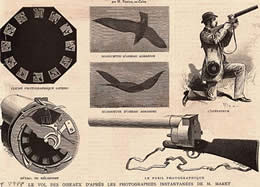
Marey's fusil photgraphique 1881-2
- designed the world's first portable motion picture camera -- a camera in the shape of a rifle
- used it to take 12 frames of birds in flight.

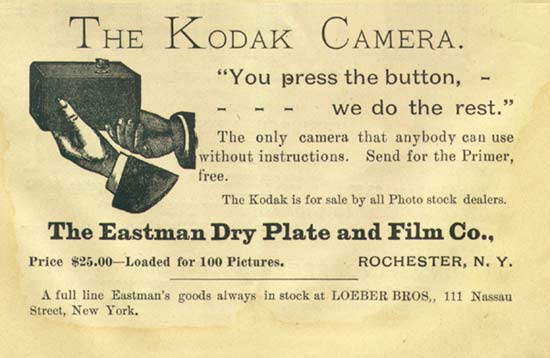
Eastman Kodak's first roll film, 1888
- made it possible for Marey to create the chronophotographe, a camera capable of taking long sequences of photographs on one strip of film.
- first "box" camera to be used by the public and its design became the archetype for cameras to come. The flexible roll film meant that the cameras were light and portable

William Dickson & Thomas Edison's Kinetoscope, 1891
- a 'peepshow' device in which images were viewed in motion
- But only one viewer at a time


The Lumieres' Cinematographe, 1895
- combined all the existing technology to create the Cinematographe, a machine that allowed an audience to watch a projection of moving images on a screen together
- first screening on 28 December 1895 in Paris: footage from 'L’Arroseur
arrosé':


The Lumieres later continued to develop the technology. Yet when Georges Melies (the one who would soon became the first artist of the medium) tried to buy a copy of the cinematographe from Antoine Lumiere, the old man refused and said, "This can be exploited for a while as scientific curiosity; beyond that it has no commercial future." (Robinson, 1971, p.23)
Sources:
Robinson, David. The History of World Cinema. 1971.
http://www.precinemahistory.net/
Kinetoscope
From Wikipedia, the free encyclopedia
Not to be confused with Kinescope.

Interior view of Kinetoscope with peephole viewer at top of cabinet
A prototype for the Kinetoscope was shown to a convention of the National Federation of Women's Clubs on May 20, 1891.[2] The first public demonstration of the Kinetoscope was held at the Brooklyn Institute of Arts and Sciences on May 9, 1893.[2] Instrumental to the birth of American movie culture, the Kinetoscope also had a major impact in Europe; its influence abroad was magnified by Edison's decision not to seek international patents on the device, facilitating numerous imitations of and improvements on the technology. In 1895, Edison introduced the Kinetophone, which joined the Kinetoscope with a cylinder phonograph. Film projection, which Edison initially disdained as financially nonviable, soon superseded the Kinetoscope's individual exhibition model. Many of the projection systems developed by Edison's firm in later years would use the Kinetoscope name.
Contents
Development

Sheet of images from one of the three Monkeyshines films (ca. 1889–90) produced as tests of an early version of the Kinetoscope
Edison assigned Dickson, one of his most talented employees, to the job of making the Kinetoscope a reality. Edison would take full credit for the invention, but the historiographical consensus is that the title of creator can hardly go to one man:
While Edison seems to have conceived the idea and initiated the experiments, Dickson apparently performed the bulk of the experimentation, leading most modern scholars to assign Dickson with the major credit for turning the concept into a practical reality. The Edison laboratory, though, worked as a collaborative organization. Laboratory assistants were assigned to work on many projects while Edison supervised and involved himself and participated to varying degrees.[6]Dickson and his then lead assistant, Charles Brown, made halting progress at first. Edison's original idea involved recording pinpoint photographs, 1/32 of an inch wide, directly on to a cylinder (also referred to as a "drum"); the cylinder, made of an opaque material for positive images or of glass for negatives, was coated in collodion to provide a photographic base.[7] An audio cylinder would provide synchronized sound, while the rotating images, hardly operatic in scale, were viewed through a microscope-like tube. When tests were made with images expanded to a mere 1/8 of an inch in width, the coarseness of the silver bromide emulsion used on the cylinder became unacceptably apparent. Around June 1889, the lab began working with sensitized celluloid sheets, supplied by John Carbutt, that could be wrapped around the cylinder, providing a far superior base for the recording of photographs.[8] The first film made for the Kinetoscope, and apparently the first motion picture ever produced on photographic film in the United States, may have been shot at this time (there is an unresolved debate over whether it was made in June 1889 or November 1890); known as Monkeyshines, No. 1, it shows an employee of the lab in an apparently tongue-in-cheek display of physical dexterity.[9] Attempts at synchronizing sound were soon left behind, while Dickson would also experiment with disc-based exhibition designs.[10]

An acre in size, Edison's exhibit at the Exposition Universelle included an entire electrical power station. (Smithsonian Institution/William J. Hammer Collection)
The question of when the Edison lab began working on a filmstrip device is a matter of historical debate. According to Dickson, in the summer of 1889, he began cutting the stiff celluloid sheets supplied by Carbutt into strips for use in such a prototype machine; in August, by his description, he attended a demonstration of George Eastman's new flexible film and was given a roll by an Eastman representative, which was immediately applied to experiments with the prototype.[17] As described by historian Marta Braun, Eastman's product
was sufficiently strong, thin, and pliable to permit the intermittent movement of the film strip behind [a camera] lens at considerable speed and under great tension without tearing ... stimulat[ing] the almost immediate solution of the essential problems of cinematic invention.[18]

Charles Kayser of the Edison lab seated behind the Kinetograph. Portability was not among the camera's virtues.
Only sporadic work was done on the Kinetoscope for much of 1890 as Dickson concentrated on Edison's unsuccessful venture into ore milling—between May and November, no expenses at all were billed to the lab's Kinetoscope account.[20] By early 1891, however, Dickson, his new chief assistant, William Heise, and another lab employee, Charles Kayser, had succeeded in devising a functional strip-based film viewing system. In the new design, whose mechanics were housed in a wooden cabinet, a loop of horizontally configured 19 mm (3/4 inch) film ran around a series of spindles. The film, with a single row of perforations engaged by an electrically powered sprocket wheel, was drawn continuously beneath a magnifying lens.[21] An electric lamp shone up from beneath the film, casting its circular-format images onto the lens and thence through a peephole atop the cabinet. As described by Robinson, a rapidly spinning shutter "permitted a flash of light so brief that [each] frame appeared to be frozen. This rapid series of apparently still frames appeared, thanks to the persistence of vision phenomenon, as a moving image."[22] The lab also developed a motor-powered camera, the Kinetograph, capable of shooting with the new sprocketed film. To govern the intermittent movement of the film in the camera, allowing the strip to stop long enough so each frame could be fully exposed and then advancing it quickly (in about 1/460 of a second) to the next frame, the sprocket wheel that engaged the strip was driven by an escapement disc mechanism—the first practical system for the high-speed stop-and-go film movement that would be the foundation for the next century of cinematography.[23]

35 mm filmstrip of the Edison production Butterfly Dance (ca. 1894–95), featuring Annabelle Whitford Moore, in the format that would become standard for both still and motion picture photography around the world.[24]
In the top of the box was a hole perhaps an inch in diameter. As they looked through the hole they saw the picture of a man. It was a most marvelous picture. It bowed and smiled and waved its hands and took off its hat with the most perfect naturalness and grace. Every motion was perfect....[25]The man was Dickson; the little movie, approximately three seconds long, is now referred to as Dickson Greeting. On August 24, three detailed patent applications were filed: the first for a "Kinetographic Camera",[26] the second for the camera as well, and the third for an "Apparatus for Exhibiting Photographs of Moving Objects".[27][28] In the first Kinetograph application, Edison stated, "I have been able to take with a single camera and a tape-film as many as forty-six photographs per second...but I do not wish to limit the scope of my invention to this high rate of speed...since with some subjects a speed as low as thirty pictures per second or even lower is sufficient."[29] Indeed, according to the Library of Congress archive, based on data from a study by historian Charles Musser, Dickson Greeting and at least two other films made with the Kinetograph in 1891 were shot at 30 frames per second or even slower.[30] The Kinetoscope application also included a plan for a stereoscopic film projection system that was apparently abandoned.[31]
In the spring of the following year, steps began to make coin operation, via a nickel slot, part of the mechanics of the viewing system.[32] By autumn 1892, the design of the Kinetoscope was essentially complete. The filmstrip, based on stock manufactured first by Eastman, and then, from April 1893 onward, by New York's Blair Camera Co., was 35 mm (1 3/8 inches) wide; each vertically sequenced frame bore a rectangular image and four perforations on each side.[33] Within a few years, this basic format would be adopted globally as the standard for motion picture film, which it remains to this day. The publication in the October 1892 Phonogram of cinematographic sequences shot in the format demonstrates that the Kinetograph had already been reconfigured to produce movies with the new film.[34]
As for the Kinetoscope itself, there is a significant disagreement over the location of the shutter providing the crucial intermittent visibility effect. According to a report by inventor Herman Casler described as "authoritative" by Hendricks, who personally examined five of the six still-extant first-generation devices, "Just above the film,...a shutter wheel having five spokes and a very small rectangular opening in the rim [rotates] directly over the film. An incandescent lamp...is placed below the film...and the light passes up through the film, shutter opening, and magnifying lens...to the eye of the observer placed at the opening in the top of the case."[35] Robinson, on the other hand, says the shutter—which he agrees has only a single slit—is positioned lower, "between the lamp and film".[22] The Casler–Hendricks description is supported by the diagrams of the Kinetoscope that accompany the 1891 patent application, in particular, diagram 2. A side view, it does not illustrate the shutter, but it shows the impossibility of it fitting between the lamp and the film without a major redesign and indicates a space that seems suitable for it between the film and the lens.[36] Robinson's description, however, is supported by a photograph of a Kinetoscope interior that appears in Hendricks's own book.[37]
On February 21, 1893, a patent was issued for the system that governed the intermittent movement of film in the Kinetograph. However, Robinson (1997) misleadingly stated that "patents for the Kinetograph camera and the Kinetoscope viewer were finally issued" in early 1893 (p. 38). As explained by Braun (1992), "except for the device used to stop and start the moving film, which was granted a patent in 1893, all the parts of the application describing the camera were ultimately disallowed because of previous inventors' claims" (p. 191). Also, Hendricks (1961) described the outcome of the camera patent similarly to Braun (pp. 136–137). The facts in sum are: (a) a patent solely for the intermittent movement apparatus was issued in February 1893; (b) all the other elements of the original Kinetograph patent applications were successfully challenged; and (c) a patent, number 589,168,[26] for a complete Kinetograph camera, one substantially different from that described in the original applications, was issued on August 31, 1897.[38]
The escapement-based mechanism would be superseded within a few years by competing systems, in particular those based on the so-called Geneva drive or "Maltese cross" that would become the norm for both movie cameras and projectors.[39] The exhibition device itself—which, despite erroneous accounts to the contrary, never employed intermittent film movement, only intermittent lighting or viewing—was finally awarded its patent, number 493,426, on March 14.[40] The Kinetoscope was ready to be unveiled.
Going public

Construction of the imposing Black Maria
began in December 1892. In order to take full advantage of sunlight,
the tar paper–lined studio was equipped with a hinged, flip-up roof and
the entire structure could rotate on a track. "It obeys no architectural
rules," declared Dickson, who found it "productive of the happiest
effects in the films."[41]

The first U.S. copyright for an identifiable motion picture was given to Edison for Fred Ott's Sneeze.
On April 14, 1894, a public Kinetoscope parlor was opened by the Holland Bros. in New York City at 1155 Broadway, on the corner of 27th Street—the first commercial motion picture house. The venue had ten machines, set up in parallel rows of five, each showing a different movie. For 25 cents a viewer could see all the films in either row; half a dollar gave access to the entire bill.[49] The machines were purchased from the new Kinetoscope Company, which had contracted with Edison for their production; the firm, headed by Norman C. Raff and Frank R. Gammon, included among its investors Andrew M. Holland, one of the entrepreneurial siblings, and Edison's former business chief, Alfred O. Tate. The ten films that comprise the first commercial movie program, all shot at the Black Maria, were descriptively titled: Barber Shop, Bertoldi (mouth support) (Ena Bertoldi, a British vaudeville contortionist), Bertoldi (table contortion), Blacksmiths, Roosters (some manner of cock fight), Highland Dance, Horse Shoeing, Sandow (Eugen Sandow, a German strongman managed by Florenz Ziegfeld), Trapeze, and Wrestling.[50] As historian Charles Musser describes, a "profound transformation of American life and performance culture" had begun.[48]

A San Francisco Kinetoscope parlor, ca. 1894–95.
One of the new firms to enter the field was the Kinetoscope Exhibition Company; the firm's partners, brothers Otway and Grey Latham, Otway's friend Enoch Rector, and their employer, Samuel J. Tilden Jr., sought to combine the popularity of the Kinetoscope with that of prizefighting. This led to a series of significant developments in the motion picture field: The Kinetograph was then capable of shooting only a 50-foot-long negative (evidence suggests 48 feet (15 m) feet was the longest length actually used).[55] At 16 frames per foot, this meant a maximum running time of 20 seconds at 40 frames per second (fps), the speed most frequently employed with the camera. At the rate of 30 fps that had been used as far back as 1891, a film could run for almost 27 seconds. Hendricks identifies Sandow as having been shot at 16 fps, as does the Library of Congress in its online catalog, where its duration is listed as 40 seconds.[56] Even at the slowest of these rates, the running time would not have been enough to accommodate a satisfactory exchange of fisticuffs; 16 fps, as well, might have been thought to give too herky-jerky a visual effect for enjoyment of the sport. The Kinetograph and Kinetoscope were modified, possibly with Rector's assistance, so they could manage filmstrips three times longer than had previously been used.[57]
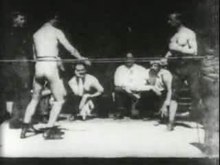
The June 1894 Leonard–Cushing bout. Each of the six one-minute rounds
recorded by the Kinetograph was made available to exhibitors for $22.50.[58] Customers who watched the final round saw Leonard score a knockdown.
Just three months after the commercial debut of the motion picture came the first recorded instance of motion picture censorship. The film in question showed a performance by the Spanish dancer Carmencita, a New York music hall star since the beginning of the decade. According to one description of her live act, she "communicated an intense sexuality across the footlights that led male reporters to write long, exuberant columns about her performance"—articles that would later be reproduced in the Edison film catalog.[62] The Kinetoscope movie of her dance, shot at the Black Maria in mid-March 1894, was playing in the New Jersey resort town Asbury Park by summer. The town's founder, James A. Bradley, a real estate developer and leading member of the Methodist community, had recently been elected a state senator:[63] "The Newark Evening News of 17 July 1894 reported that [Senator] Bradley...was so shocked by the glimpse of Carmencita's ankles and lace that he complained to Mayor Ten Broeck. The showman was thereupon ordered to withdraw the offending film, which he replaced with Boxing Cats."[64] The following month, a San Francisco exhibitor was arrested for a Kinetoscope operation "alleged to be indecent."[65] The group whose disgruntlement occasioned the arrest was the Pacific Society for the Suppression of Vice, whose targets included "illicit literature, obscene pictures and books, the sale of morphine, cocaine, opium, tobacco and liquors to minors, lottery tickets, etc.," and which proudly took credit for having "caused 70 arrests and obtained 48 convictions" in a recent two-month span.[66]

Advertisement announcing the initial Kinetoscope exhibition in London, held on October 17, 1894.
Kinetophone

The 1895 version of the Kinetophone in use, showing the earphones that lead to the cylinder phonograph within the cabinet

Test film made for the Kinetephone system in 1894/5, to test
synchronization of film and sound. Film was preserved at the Library of
Congress with no sound; wax cylinder recording later found at the Edison
National Historic Site, and both were combined using digital methods to
recreate the original film.[73]
Even as Edison followed his dream of securing the Kinetoscope's popularity by adding sound to its allure, many in the field were beginning to suspect that film projection was the next step that should be pursued. When Norman Raff communicated his customers' interest in such a system to Edison, the great inventor summarily rejected the notion:
No, if we make this screen machine that you are asking for, it will spoil everything. We are making these peep show machines and selling a lot of them at a good profit. If we put out a screen machine there will be a use for maybe about ten of them in the whole United States. With that many screen machines you could show the pictures to everybody in the country—and then it would be done. Let's not kill the goose that lays the golden egg.[79]Under continuing pressure from Raff, Edison eventually conceded to investigate the possibility of developing a projection system. He seconded one of his lab's technicians to the Kinetoscope Company to initiate the work, without informing Dickson. Dickson's ultimate discovery of this move appears to have been one of the central factors leading to his break with Edison that occurred in spring 1895.[80]
Projecting Kinetoscopes

In the first decade of the 1900s, years before developing the compact
Home Projecting Kinetoscope, Edison marketed an essentially theatrical
35 mm Projecting Kinetoscope for domestic use.
By the beginning of 1896, Edison had turned his attention to promoting a projector technology, the Phantoscope, developed by young inventors Charles Francis Jenkins and Thomas Armat. The rights to the system had been acquired by Raff and Gammon, who redubbed it the Vitascope and arranged with Edison to present himself as its creator.[83] With Dickson having left his employ, the Kinetophone was soon mothballed and Edison suspended work on sound cinema for an extended period. Departing the Vitascope operation after little more than a year, Edison commissioned the development of his own projection systems, the Projectoscope and then multiple iterations of the Projecting Kinetoscope. In 1912, he introduced the ambitious and expensive Home Projecting Kinetoscope, which employed a unique format of three parallel columns of sequential frames on one strip of film—the middle column ran through the machine in the reverse direction from its neighbors. It was a commercial failure.[84] Four years later, the Edison operation came out with its last substantial new film exhibition technology, a short-lived theatrical system called the Super Kinetoscope. Much of the Edison company's most creative work in the motion picture field from 1897 on involved the use of Kinetoscope-related patents in threatened or actual lawsuits for the purpose of financially pressuring or blocking commercial rivals.[85]

Image of a Projecting Kinetoscope published in 1914
See also

- History of film
- List of film formats
- Motion Picture Patents Company
- William Friese-Greene
First film poster,in India - for the first film show in India
- by Lumière brothers,

- at Watson hotel-Bombay
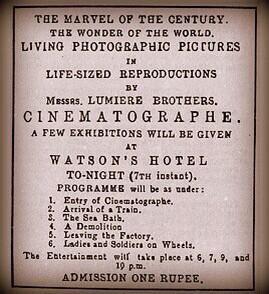
THE FOLLOWING 6 FILMS WERE SHOWN FOR ONE RUPEE TICKET
The Lumiere Brothers - "Arrival of a Train at La Ciotat" - First ...

https://www.youtube.com/watch?v=d_9N68MO9gM
Jan 7, 2013 - Uploaded by Cinema History
"L'arrivée d'un train en gare de La Ciotat" (translated from French into English as "The Arrival of a Train ...Lumiere brothers : first film of the cinema! - YouTube

https://www.youtube.com/watch?v=sHhPWiTz_zc
Sep 12, 2007 - Uploaded by PUMit
Lumiere brothers : first film of the cinema! ... the Lumiere brothers, who invented the cinema in Lyon, France ...The Sea (1895) - LOUIS LUMIERE - La mer - YouTube

https://www.youtube.com/watch?v=CAbTn3KzkgY
May 12, 2012 - Uploaded by Change Before Going Productions
The first public screening of films at which admission was charged was held on December 28, 1895, at Salon ...Demolition of a Wall (1896) - 1st Reverse Motion in Film ...

https://www.youtube.com/watch?v=9p0HI9t5IB0
Feb 22, 2012 - Uploaded by Change Before Going Productions
In Demolition of a Wall (aka Démolition d'un mur) by Louis Lumière, we ... The Mechanical Butcher (1895 ...Film Compilation, 1890's - Film 12003 - YouTube

https://www.youtube.com/watch?v=brUA5Onv_XU
Jul 18, 2014 - Uploaded by HuntleyFilmArchives
Compilation of mainly or wholly Lumiere films. ... Boy wears girls' clothes? ... Men (possibly soldiers) swim ...
1895, Lumiere, Workers Leaving the Lumiere Factory (1895 ...

https://www.youtube.com/watch?v=DEQeIRLxaM4
Feb 8, 2011 - Uploaded by MediaFilmProfessor
La sortie des usines Lumière (three different versions) Movies for mass public consumption are considered to be ...Cranking 1910 projector ...

https://www.youtube.com/watch?v=SFaQwDvQLaE
Oct 12, 2009 - Uploaded by "Floydster"
We were privileged to have Joe and his restored projector at our Sons of the Desert Early to Bed Tent meeting ... Film Studies: Lumiere Brothers & The Cinematographe
Bombay Photo Images[ Mumbai]: Painting Of Watson's Esplanade Hotel ...


watson Hotel 1900
First commercial movie screened - Dec 28, 1895 - HISTORY ...

www.history.com/.../first-commercial-movie-screen...
Lumière Brothers - The Serpentine Dance (c.1899) - YouTube

https://www.youtube.com/watch?v=UkT54BetFBI
Aug 15, 2006 - Uploaded by 317East32nd
Lumière Brothers - The Serpentine Dance (c.1899). 317East32nd ... cinematic ART. One of my three favorite ...Snowball Fight (1896) - Classic Lumière Film - YouTube

https://www.youtube.com/watch?v=BgpHyVUoLUA
Apr 21, 2015 - Uploaded by All Classic Video
Snowball Fight (1896) - Classic Lumière Film ... On both side of the pathway, several men and women are ...The Lumiere Brothers' - First films (1895) - YouTube

https://www.youtube.com/watch?v=4nj0vEO4Q6s
Dec 22, 2006 - Uploaded by Siyanure
The Lumiere Brothers' - First films (1895). yalpertem ..... Two of its residents, namely the Lumiere bros ...Discovery of Film Camera : Paris to Bombay - YouTube

https://www.youtube.com/watch?v=kbsYlLG-sAc
Mar 29, 2013 - Uploaded by Satyaprakash Gupta
The Lumiere cinematograph was the culmination of long journey that ... show in Paris on December 28,1895 ...


Early Cinema, Projectionist using Hand Crank Film Projector, Cinema Audience
From the Kinolibrary Archive Film collections. To order the clip clean and high res or to find out more visit ...

SALIM BIOSCOPEWALA #Kolkata film festival
India's last bioscopewala Mohammad Salim was honoured at the fest on Saturday for keeping the tradition of travelling movie ...

Witness Prakash Travelling Cinema 22 Oct Part 1
One of the worlds smallest cinemas, hand powered film projector from the early days of entertainment rolls through the busy ...
 9:44
9:44
I HAVE A 1900 KINETOSCOPE projector; AND A FEW OTHER HAND CRANKED FILM PROJECTORS AND CAMERAS OF 1900- 1930 ERA,FEW FILMS OF THAT ERA ALSO; COLLECTED BY ME AS A HOBBY..
CONTACT ME AT bombaymann@gmail.com.
IT IS FOR SALE TO THE HIGHEST BIDDER
I HAVE ALREADY DONATED ANOTHER COLLECTION OF MUSIC INSTRUMENTS TO NEHRU SCIENCE MUSEUM AT WORLI ,MUMBAI CITY ,WHICH CAN BE SEEN ON THE SECOND FLOOR ,UNDER MY REAL NAME .
Witness Prakash Travelling Cinema 22 Oct Part 2
One of the worlds smallest cinemas, hand powered film projector from the early days of entertainment rolls through the busy ...
I HAVE A 1900 KINETOSCOPE projector; AND A FEW OTHER HAND CRANKED FILM PROJECTORS AND CAMERAS OF 1900- 1930 ERA,FEW FILMS OF THAT ERA ALSO; COLLECTED BY ME AS A HOBBY..
CONTACT ME AT bombaymann@gmail.com.
IT IS FOR SALE TO THE HIGHEST BIDDER
I HAVE ALREADY DONATED ANOTHER COLLECTION OF MUSIC INSTRUMENTS TO NEHRU SCIENCE MUSEUM AT WORLI ,MUMBAI CITY ,WHICH CAN BE SEEN ON THE SECOND FLOOR ,UNDER MY REAL NAME .