
film (Rukvamati's Mansion)(1991)-[genre- off beat]


Rukmavati Ki Haveli (1991) (Hindi: रुक्मावती की हवेली; English: Rukmavati's Mansion) is an Indian feature film.
The film is directed by Govind Nihalani and is based on Federico Garcia Lorca's Spanish play The House of Bernarda Alba. The screenplay is written by Nihalani himself.[1]
Nahar Singh starts courting the eldest daughter Savitri but the youngest daughter Padma falls in love with him. He also responds to her. This makes Mumal jealous of her. One night as Padma goes out with Nahar, Mumal follows them leading to a confrontation. Rukmavati fires at Nahar. Padma commits suicide. Rukmavati, shaken but unbending still, has only to say, "My daughter died a virgin."[2]
(Rukmavati Ki Haveli) (1991)


Jul 25, 1991 - Complete information on bollywood movie: Rukmavati Ki Haveli Star cast, Movie Rating, Reviews, Plot, Screenshots, Song listing, Trailer, ...
As far as onscreen villains go, Prashant Narayanan's portrayal of Dheeraj Pandey, a self-turned eunuch and a psychopath serial killer in Murder 2 is by far the most fear-provoking. Prashant switches shades like a chameleon in the film and makes your spine chill when he sings 'Kitna mazaa aaya. Tere tukde karoon chaar' while killing his victims. Prashant started off by assisting Art Director Samir Chanda and worked on films like Govind Nihalani's Rukmavati Ki Haveli, Subhash Ghai's Saudagar and Shyam Benegal's Sardari Begum. He got his first break in Hansal Mehta's Chhal and went on to deliver power packed performances in films like Waisa Bhi Hota Hai Part II, Shadows Of Time, Yeh Saali Zindagi and Bhindi Baazaar Inc. Even though this gifted actor was appreciated for his performances in these films, none of these films were successful at the box office, but Murder 2 »
- Bollywood Hungama News Network
Showing results for film (Rukmavati Mansion)(1991) Search instead for film (Rukvamati's Mansion)(1991)
Showing results for film (Rukmavati Mansion)(1991)songs Search instead for film (Rukvamati's Mansion)(1991)songs
 36:04
36:04
There is no music in the film.


Rukmavati Ki Haveli
From Wikipedia, the free encyclopedia
| Rukmavati Ki Haveli | |
|---|---|
| Directed by | Govind Nihalani |
| Written by | Federico García Lorca (play) Govind Nihalani (screenplay) |
| Starring | Uttara Baokar, Ila Arun, Kitu Gidwani, Jyoti Subhash, Pallavi Joshi, Sohaila Kapur, Suneeta Sengupta. |
| Music by | Ila Arun |
| Cinematography | Govind Nihalani |
| Country | India |
| Language | Hindi |
The film is directed by Govind Nihalani and is based on Federico Garcia Lorca's Spanish play The House of Bernarda Alba. The screenplay is written by Nihalani himself.[1]
Plot
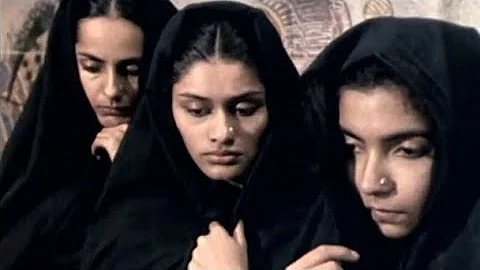
Nihalani's screenplay transports Lorca's Spanish setting on to a Rajasthan village. Rukmavati, a domineering matriarch has five daughters Savitri, Damayanti, Chandra, Mumal and Padma, all unmarried. The domineering woman has inexorable control over her daughters placing them all in a repressive setting where they don't have any social life of their own outside their home. The frustrated and angry daughters respond in their individual ways to their mother’s cruelty leading to a tragic ending.Nahar Singh starts courting the eldest daughter Savitri but the youngest daughter Padma falls in love with him. He also responds to her. This makes Mumal jealous of her. One night as Padma goes out with Nahar, Mumal follows them leading to a confrontation. Rukmavati fires at Nahar. Padma commits suicide. Rukmavati, shaken but unbending still, has only to say, "My daughter died a virgin."[2]
Awards
Ajay Munjal and A.M. Padmanabhan won the 39th National Film Award for best audiography and Samir Chanda for best art direction for the film.Cast of characters


Haunted Mansion 1991 - ExpertVacations.com - Vintage WDW ...

https://www.youtube.com/watch?v=ww6dQTqXfSQ
Jul 9, 2011 - Uploaded by ExpertVacations
ExpertVacations.com presents Vintage Walt Disney World home videos - the Haunted Mansion shot in 1991 ...Rukmavati Ki Haveli (1991) - IMDb
www.imdb.com/title/tt0248384/
Rating: 7.3/10 - 13 votes
Add a Plot » ... 16 Last-Minute Actor Swaps That Changed Films ForeverRukvamati's Mansion (1991) - News - IMDb
www.imdb.com/title/tt0248384/news?year=2011
Prashant switches shades like a chameleon in the film and makes your spine chill when he sings 'Kitna mazaa aaya. Tere tukde karoon chaar' while killing his
Rukvamati's Mansion (1991) - News - IMDb
www.imdb.com/title/tt0248384/news?ref_=ttfc_ql_rel_1
(Rukmavati Ki Haveli) (1991)


Rukmavati Ki Haveli (1991) | Hindi Movie Review, Songs, Trailer ...
muvyz.com/moviepage/by366897


Rukmavati Ki Haveli (1991) - IMDb
www.imdb.com/title/tt0248384/
Rating: 7.3/10 - 13 votes
Add a Plot » ... 16 Last-Minute Actor Swaps That Changed Films ForeverAs far as onscreen villains go, Prashant Narayanan's portrayal of Dheeraj Pandey, a self-turned eunuch and a psychopath serial killer in Murder 2 is by far the most fear-provoking. Prashant switches shades like a chameleon in the film and makes your spine chill when he sings 'Kitna mazaa aaya. Tere tukde karoon chaar' while killing his victims. Prashant started off by assisting Art Director Samir Chanda and worked on films like Govind Nihalani's Rukmavati Ki Haveli, Subhash Ghai's Saudagar and Shyam Benegal's Sardari Begum. He got his first break in Hansal Mehta's Chhal and went on to deliver power packed performances in films like Waisa Bhi Hota Hai Part II, Shadows Of Time, Yeh Saali Zindagi and Bhindi Baazaar Inc. Even though this gifted actor was appreciated for his performances in these films, none of these films were successful at the box office, but Murder 2 »
- Bollywood Hungama News Network
Director:
Govind NihalaniCast
| Credited cast: | |||
 |
Ila Arun | ||
 |
|
||
| |
Jyoti Subash Chandra Jyoti Subash Chandra - IMDb |
||
 |
Kitu Gidwani | ... |
(as Kittu Gidwani)
|
 |
Pallavi Joshi | ||
| |
|
||
Edit
See full technical specs »
Details
Country:
IndiaLanguage:
HindiAlso Known As:
Rukvamati's Mansion See more »Company Credits
Show detailed
company contact information
on
IMDbPro »
Technical Specs
Color:
ColorSearch filters




Search filters


Rukmawati Ki Haveli (1999) - YouTube

https://www.youtube.com/watch?v=b5FcGrrzfYY
Apr 18, 2014 - Uploaded by Qaseem Abbasi
Rukmavati ki Haveli Part-2 - Duration: 35:38. Mohit Bhalla 145 views. 35:38. Surkhaab | New Release ...

Rukmavati ki Haveli Part-2


There is no music in the film.
Interview with Govind Nihalani. Rukmavati Ki Haveli: Creating ...
www.revistafotocinema.com › Inicio › No 13 (2016)
by A Rodrigo Mateu - 2016
25 years after filming Rukmavati Ki Haveli (1991), the Hindi movie .... There is only one song which they hear being sung from outside, which is there in the play
INTERVIEW WITH GOVIND NIHALANI
RUKMAVATI KI HAVELI: CREATING EMOTIONAL LANDSCAPES
Amparo Rodrigo Mateu
University of Mumbai, India
amparorodrigo@gmail.com
25 years after filming Rukmavati Ki Haveli (1991), the Hindi movie adaptation of Lorca's play La casa de Bernarda Alba (Federico
García Lorca, 1936), Mumbai-based Indian filmmaker and former cameraman
Govind Nihalani (Karachi, 1940) vividly remembers the effect it had on
him and relates how he adapted the play from Lorca's Spanish Andalusia
to a film with an Indian background.
1
-Why did you choose Lorca and, among all his works, what attracted you to La casa de Bernarda Alba?
I
always liked theater and I was very close to a well-known Hindi theatre
director. His name was Satyadev Dubey. He used to do English plays and
he spoke to me a lot about some plays from Europe. Among them, he spoke
about Lorca and this particular play. I had not read it but he described
it as a strong play, so I became curious. I bought an English
translation and I read it. I liked the play very much because of its
theme: authoritarianism and the rebellion against authoritarianism. I
read it, I liked it and, then, I forgot about it.
One
day, I went to Jaisalmer, in Rajasthan. As I was going up the fort, I
saw a group of Rajasthani women walking down. All of them -they must
have been a particular tribe- were dressed in brown petticoats, brown
skirts and black duppatas[1] and chadars[2], and
wearing old silver jewelery. It was a very stark combination of colors,
coming against the stone walls of the fort. That vision was very
striking. They walked down and they passed me. I couldn't forget the
visual of these women.
Then I started making films and I thought that somewhere this visual needed to come up. I made a huge TV serial called Tamas (1988).
It was a big theme. After that I felt exhausted and I wanted to do
something intimate, something smaller, so I put up a proposal to attempt
one of three European plays. I gave them The Father (1887), by August Strindberg (Sweden, (1849-1912); Little Eyolf (1894), by Henrik Ibsen (Norway, 1828-1906), and then I chose Lorca's play The House of Bernarda Alba (La
casa de Bernarda Alba) as my third project. Three European plays
adapted in Indian surroundings. The proposal was given to Indian
television and they said I could go ahead.
When I read The House of Bernarda Alba again,
the same image of those women coming down that fort kept haunting me,
so I decided to take that forward and I decided to place it in Rajasthan
because Rajasthan is very close to the original play, since it is a
very feudal culture, particularly in olden times. I thought that these 7
women -one mother, one maid and the five girls- in an old haveli[3] would be wonderful. So I decided to go for this play and make it into a film. I was very thrilled.
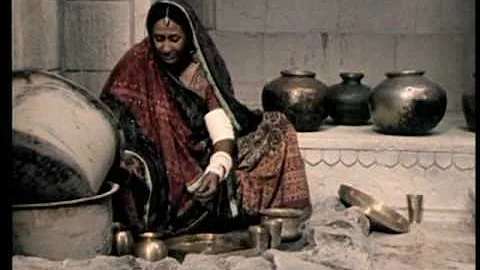
I recreated the entire environment of a Rajasthani haveli and
I gave these women the same color, the same kind of dress which I had
seen. In my film you see the women also dressed in deep red, maroon and
black and, of course, there is no jewelery because the ladies are
widows.
Apart from that I
liked the theme as well. I was able to combine my aesthetic sensibility,
my cinematic sensibility and my social and political concerns. And I
was lucky to get very good actresses at that time. That is how you make a
film.
2
-How do you translate the fear, the oppression and the claustrophobia portrayed in the original into your film?
When
you are adapting a play you cannot be literal. You cannot adapt word by
word. You have to identify the theme and look for similar expressions
in your own culture and your own language. The language I have used in
my play is the feudal Rajasthani language. The way they would refer to
their father or the way the daughters would address their mother is not a
contemporary reference. It is a particular kind of dialect from
Rajasthan. Even though the film is in Hindi language, we used some words
as highlights to suggest a dialect being used. You cannot make it 100%
in dialect. Nobody would understand it today. It was all a combination
of finding the right linguistic expression, taking some words that would
give me a suggestion of feudal society. It is like the way you address
your elders, your boss or your servants. It reflects what kind of class
you belong to, what kind of society this is.
Then, the architecture and the dimensions of the haveli also play a role in it because they are made of old stone. Normally, these havelis will
have a combination of big stones covered with plaster, in grey, white
or yellow colors. I used stones, covered them with very thin paint and
allowed them to show the texture of the stone underneath. And there is a
particular kind of murals, paintings, of military-like figures, like
elephants or horses. They are very popular and you will find them
outside the doors, or sometimes inside also. Normally murals are very
big because walls in feudal houses are big, showing power. So these
people are trapped within high walls made of stone. It looks like a
prison. And besides, in these havelis,
in these mansions in Rajasthan, with their high walls, the sunlight
does not come in easily. Only when the sun is on the top, does the
sunlight come in. So, most of the time, the interiors where women live
are in shadow, allowing only soft light but not direct sunlight. Direct
sunlight comes but for a very short time during the day. Even in terms
of lighting, in terms of photography, I did not use direct sunlight. I
used reflected light. There is a general light but there is no sunlight.
Only when grilled windows appear, I show some sunlight coming in, just
that much, not more.
3
-I guess being a cameraman also helped.
It
was conceived much before. That is how the scene was built. We decided
on the size of the walls and from where the lighting would come. All
these were well thought of before we erected them.
4
-What is the visual personality of the film that determines the particular kind of lighting?
Everything
was designed to create the impression of their voices having been
silenced. There is no light in their lives. So everything had to create
the impression that they are trapped inside, that they cannot escape.
The whole thing is about breaking the walls and going out. That is what
the rebellion is about: the youngest wanting to go out and escape from
the entrapment. They should feel that they are trapped inside and that
they cannot break through. The walls are too strong. Literally,
philosophically, the authority is too strong. You cannot defy the
authority and go even out of the door of your house.
I
played on the mood, which was a state of total helplessness, so they
can only feel angry. They cannot do anything. And the youngest going out
and having a rendez-vous becomes
a great defiance of the rules laid down by society. The last line of
the play I think is a great line, when the mother says that her daughter
died a virgin. She thinks that it would be a great stigma on the honor
of the house that the youngest person went out and had an affair with
somebody out of marriage. She is not prepared to accept it. These are
the codes of conduct, which are accepted in civil society and this is
very true, even today in some parts.
5
-Bernarda
is the most powerful character in the story. How did you approach her,
from a technical point of view, to give her the authority that she has?
Bernarda
is played by one of the best theater actresses at that time. There was
hardly any make-up on her. I did not try to beautify her but, in fact, I
tried to come out with the rawness of her face. And that was done with
the lighting. It is about very simple tricks of lighting. As cameramen
we know how to do it. And it worked well.
Also
the way, the kind of body language she created, the strains and the
fact that she is a widow and she has to dominate even though she does
not have the support of her husband. The way she did it was amazing. I
did not have to do anything else. She understood the character very
well.
6
-How was the filming process?
Before
we came on the set, at the same studio where we were going to shoot,
since they were a family, I said they should get to know each other very
well. They had to sit against each other, they had to play with each
other... I wanted to create a sense of togetherness. I wanted them to be
good friends with each other. Then, during 7 or 10 days, we rehearsed
the dialogues but we did not rehearse the movements. I did not tell them
“you have to move from A to point B or point C”. They just had to sit
down on chairs and read and read again and, if they had any problem with
any sentence or word, we clarified them.
When
they came on the set, that is when I gave them the costumes and
information about their movements. Beforehand nobody knew where the
camera was going to be. Nobody knew from which point to which point they
were going to walk or sit or sleep or jump. They only knew the lines. I
also asked them not to show emotions while reading the lines, but to
read them neutral, just trying to get the meaning of the line, the
unspoken meaning, which is not so obvious in the written word. I asked
them to understand before speaking.
They
were all theater actresses, so they were used to learn lines and to
perform on stage. I wanted theater actresses because, having worked in
cinema here, I know there are few actresses who can remember long lines
like these without a break. “Come on the set. Move around and discover
your own space” -I told them.
So
once we all came on the set and I gave them the movements. They were
ready with the lines. The only thing I had to concentrate on was the
finer points of acting. It went off very well. I really enjoyed working
on this. We shot the movie in about two weeks, all of it on the same
stage and without any music.
7
-What is the role of the music or, should I say, the absence of it?
The
entire film has not a single note of background music. There is no
music in the film. There is only one song which they hear being sung
from outside, which is there in the play as well. They just hear that.
And it is not a song with lots of instruments. It is mostly voices.
There is no music. I told my actors: “Whatever you say, it has to be so
well spoken that you should not feel the need for music”. I said: “I am
not going to use music to underline either sadness or happiness or
excitement”.
8
-How do the composition and colors chosen complement one another?
The
colors are very limited. There are just three shades. There is nothing
you have to look at in the frame. You are forced to look at their faces.
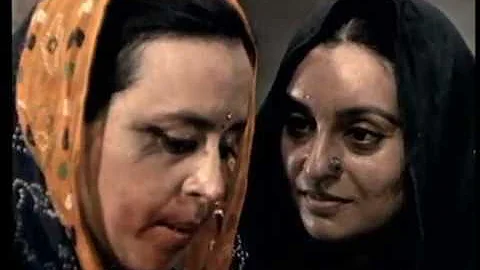
And their faces were my landscapes. The expressions of their faces
became the emotional landscapes. Characters come out very strongly when
you have stark colors like grey, maroon and black. In most of my
compositions, since they are built in medium shots and close-ups, black
dominates because they highlight their faces, their clothes.
All
compositions are used to emphasize the dominance of the color black.
Black becomes synonymous with authority. Therefore, you just see the
shapes of blacks moving everywhere and their faces. That becomes the
most important element of the composition of the frames.
I
composed it in such a way that only the important faces will be seen
and, wherever there is a longer shot, it will be dominated by these
black shapes. All that you see are the black forms of the women and
their faces as they look at each other revealing their emotions. Nothing
else.
And the architecture
of the mansion is the typical Rajasthani one, with the alcoves and grey
stones on the walls at the back. There are no accessories lying
anywhere. It is stark. Even the lighting, it is dim. There is no
sunlight filtering anywhere. It is all grey.
9
-It seems reduced to a kind of simplicity, with very few elements.
Yes,
very few. The more things you put in, the less stark it becomes. When
there are not many things, then you feel the lack of them, so the use of
lighting becomes even more difficult. If you see many things, then you
feel comfortable, because things are there, you can focus on this or
that... Nothing like that happens here.
10
-Lorca's
play has a religious component, with a church service and a mourning
situation as context. How was the cultural adaptation?
The
mourning and everything around it is more or less there in all
cultures. It was a question of finding a parallel. But you cannot find
an exact equivalent. There has to be some kind of adjustment. You have
to find the nearest similarity. And that I found because in our case
there is also a period of mourning. There is only one thing that we do
not have, a church. But we have temples. So that is the only adjustment
that I had to make.
11
-How was the movie received in India?
For
the Indian audience -unless they were told that this was an adaptation
of a Spanish play- it was an Indian play which narrated an Indian story
because it looked very real to them. Surprisingly, nobody enquired about
Lorca because they thought it was an Indian story.
I
have shown this film in a college in Spain and they were amazed. They
said: “We cannot recognize it as our play”. For them it looked like an
Indian play. So I would consider it to be a successful adaptation
because it makes you forget that you have seen a similar work which has
been written in another culture or in another language in another
country. It became like your own. That should be seen as a very positive
response.
12
-And
it is about two adaptations, i.e. a cultural adaptation from Andalusian
Spain into Rajasthani India, and a genre adaptation from a theater play
into a movie script.
And
you must remember one thing. I have not edited the play at all. The play
is exactly the same as written in Spanish. But I took the English
translation. So whatever editing has been done, if at all, is in the
English translation. Sometimes we did not use the words and expressions
from the original but we did not throw them out. We found a parallel in
our language.
13
-Do you have any future similar adaptations in mind?
I am a great fan of Lorca and one of my ambitions is to do a trilogy. Yerma (Federico García Lorca, 1934) is a very popular play here in India, particularly in drama schools. I want to adapt Yerma and also Blood Wedding (Bodas
de sangre, Federico García Lorca, 1931) into cinema, with Indian
characters and Indian dresses. If I get some funding, that is what I
would like to do.
Filmography
Aakrosh (Hindi, 1980)
Vijeta (Hindi, 1982)
Ardh Satya (Hindi, 1983)
Party (Hindi, 1984)
Aghaat (Hindi, 1985)
Tamas (Hindi, TV serial, 1987)
Drishti (Hindi, 1990)
Pita (Hindi, 1991)
Rukmavati Ki Haveli (Hindi, 1991)
Jazeere (Hindi, TV series, 1991)
Drohkaal (Hindi, 1994)
Sanshodhan (Hindi, 1996)
Hazaar Chaurasi Ki Maa (Hindi, 1997)
Thakshak (Hindi, 2000)
Deham (English, 2001)
Dev (Hindi, 2004)
Kamlu Happy Happy (English, Animated Feature Film, 2012)
Fly Kamlu Fly (English, Animated Feature Film, Under Production).